
It is a common laundry day scenario: a premium linen shirt or beloved set of sheets goes into the machine looking great, only to emerge from the dryer looking like it belongs to a small child.
If you are staring at a seemingly ruined garment and asking, does linen shrink in the dryer, the short answer is yes. But before you throw the item away, you should know that the fabric is rarely permanently destroyed. Linen is a natural flax fiber, and what often looks like catastrophic shrinkage is actually just the weave tightening up and losing its moisture.
Whether you are dealing with a laundry accident or trying to figure out if your appliance is running too hot—which might require professional dryer repair Toronto services—here is the factual breakdown of how linen reacts to heat, and how you can fix it.
The Reality of Linen Shrinkage
Linen fibers are incredibly durable, but they are highly reactive to tension, water, and heat. When flax is woven into fabric, the natural fibers are pulled straight. When exposed to heat and the tumbling agitation of a dryer, those fibers relax back into their natural, slightly wavy state, causing the fabric to contract.
The amount of shrinkage depends almost entirely on the quality of the material.
| Linen Type | Expected Shrinkage | Behavior in the Dryer |
| Cheap / Non-Prewashed | 10% to 15% | Drastic contraction if exposed to high heat. |
| Quality Pre-Washed | 3% to 5% | Minor settling; most shrinkage occurred during manufacturing. |
| Over-Dried / Baked | Varies | Fibers can permanently tighten and weaken over time. |
The Main Culprit: It is not necessarily the dryer itself that ruins linen—it is high heat combined with overdrying.
How to “Unshrink” Your Linen
If a hot dryer cycle has tightened your linen into a mass of heavy wrinkles, you can usually relax the weave and restore the drape using moisture and steam.
The Re-Wetting Method
-
Soak the shrunken linen in lukewarm water for 15 to 30 minutes.
-
Add a tiny drop of mild hair conditioner to help soften the fibers (optional).
-
Squeeze the excess water out gently—do not wring or twist the fabric.
-
Lay the item flat on a dry towel and gently pull or stretch the fabric back into its original shape.
-
Hang to air dry. For items like curtains or tablecloths, attach small clips or weights to the bottom hem to pull the fabric straight as it dries.
The Steam Method
-
Fill a steam iron or garment steamer with distilled water.
-
Mist the linen generously with a spray bottle so it is visibly damp.
-
Apply steam directly to the fabric while gently pulling the edges.
-
Iron outward from the center to the corners to relax the tightened weave.
The Safe Way to Dry Linen Moving Forward
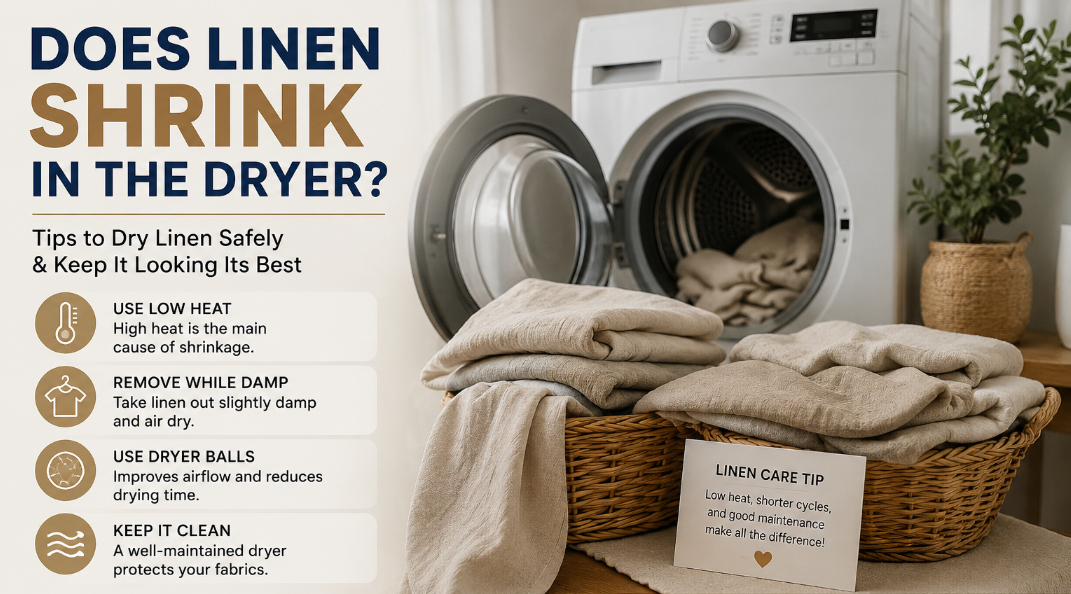
To avoid the panic of shrunken clothing in the future, you just need to adjust your laundry habits. Linen can survive the dryer if you follow a few strict rules.
-
Wash cool: Stick to cold or lukewarm water on a gentle cycle.
-
Use low heat: Set your dryer to the lowest possible heat setting or use an air-fluff cycle.
-
Use dryer balls: Wool dryer balls improve airflow and reduce drying time, which keeps the fabric from overheating.
-
Never dry completely: Remove linen while it is still slightly damp.
-
Finish with air: Hang the damp linen or lay it flat to finish drying naturally.
When It Is Not the Fabric, It Is the Appliance
Sometimes, you follow all the rules—you select the delicate cycle and the lowest heat setting—but your clothes still come out scorching hot, heavily wrinkled, and shrunken.
When this happens, it is a mechanical issue, not user error.
A malfunctioning dryer can easily destroy natural fibers like linen, cotton, and wool. Common appliance failures that lead to fabric damage include:
-
Broken or faulty thermostats that fail to regulate internal temperatures.
-
Clogged dryer vents restricting airflow and causing heat buildup.
-
Defective moisture sensors that allow the cycle to run far longer than necessary.
-
Damaged heating elements that default to high heat regardless of the setting you choose.
Common Heating and Airflow Error Codes
When a dryer’s airflow is restricted, internal temperatures spike, and the machine has to work twice as hard—often resulting in damaged fabrics and a potential fire hazard. Modern dryers will usually throw a specific error code to warn the user that the system is choked.
| Brand | Error Code | Meaning & Solution |
| Whirlpool | AF or F4 E3 | Restricted Airflow. Indicates a clogged lint screen, crushed vent hose, or blocked exterior vent. |
| LG | d80, d90, d95 | Duct Blockage. The number indicates the percentage of airflow restriction (80%, 90%, or 95% blocked). |
| Samsung | tE, hE, HC | Temperature / Heating Error. Often points to a faulty thermistor, lint buildup, or an overheating heating element. |
| Maytag | AF | Air Flow Restriction. The dryer cannot move air properly, usually due to a severely clogged exhaust vent. |
If you suspect your appliance is running too hot and damaging your wardrobe, the team at Sam Appliance Repair can help. Operating a faulty dryer is not only bad for your clothes, but it can also be a significant fire hazard and a drain on your energy bill.
For fast, accurate, and reliable dryer repair Toronto, our technicians can diagnose and replace faulty thermostats, clear out dangerous vent clogs, and get your appliance back to functioning safely and efficiently. You can trust us to protect your home—and your favorite linen shirts.